
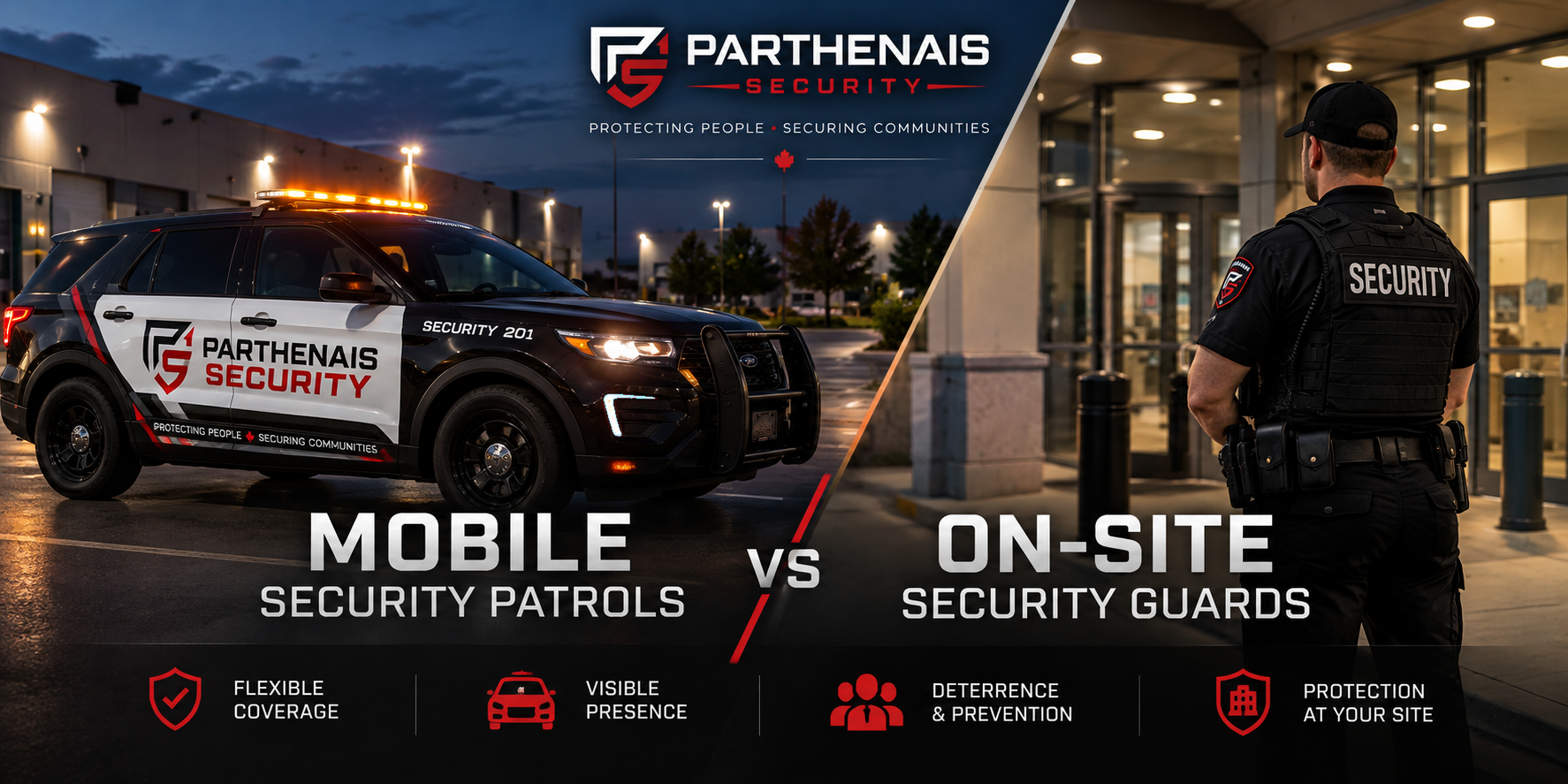
For a business owner, security often comes down to a deceptively simple question: Do I need someone on-site at all times, or would scheduled and unpredictable patrol visits be enough? The answer depends on the property, the people using it, the hours of operation and the consequences of something going wrong.
Both mobile security patrols and on-site security guards can play an important role in protecting commercial properties. But they are not interchangeable. Understanding the difference can help businesses in Cornwall and Stormont, Dundas & Glengarry (SD&G) invest in appropriate protection without paying for coverage that does not match their needs.
What is a mobile security patrol?
A mobile security patrol involves a security professional travelling between client properties and visiting each site according to an agreed plan. Visits may be scheduled, varied within approved windows, or triggered by a specific request. The patrol guard is not continuously stationed at one location.
Depending on the property's needs and the agreed scope of service, a patrol visit may include checking accessible doors and gates, inspecting exterior areas, looking for signs of damage or unauthorized activity, identifying safety concerns, documenting observations and notifying the appropriate contact when something needs attention.
Some mobile programs can also incorporate lock-and-unlock duties, vacant-property checks or alarm-response arrangements. Those services require clear instructions and must be specifically included in the agreement. An occasional patrol does not mean someone is watching the property between visits.
What does an on-site security guard do?
On-site security places a guard at a designated property for an agreed shift. Rather than visiting briefly and moving on, the guard remains assigned to the location and may perform regular patrols within the site, monitor access points, assist visitors, observe camera feeds, document incidents and respond to issues as they develop.
This model is especially valuable when a property needs continuous physical presence, frequent interaction with people, or immediate attention from an already-present guard. A distribution facility, busy commercial site, residential complex or public-facing event may have responsibilities that a periodic vehicle patrol simply cannot cover.
Continuous presence does not mean one guard can watch every corner simultaneously or prevent every incident. Staffing levels, building design, site procedures and communications still matter.
Mobile patrol vs. on-site guard: a side-by-side comparison
Coverage: A mobile guard visits at intervals, leaving gaps between checks. An on-site guard remains assigned to the location during the contracted shift.
Response: An on-site guard may be able to assess an incident sooner because they are already present. A mobile guard must travel to the property, and arrival depends on dispatch arrangements, distance, weather, road conditions and other commitments. No response time should be assumed unless it is expressly agreed and operationally supportable.
Cost structure: Mobile patrols may be more economical for properties that only need periodic checks because the guard's time is shared among assignments. Dedicated guards generally require payment for the hours they remain assigned to the site. Actual pricing varies with frequency, duties, staffing, risk and coverage requirements.
Visibility: A staffed post offers sustained presence. A marked mobile patrol may provide occasional visible deterrence, but it should not be presented as equivalent to round-the-clock supervision.
When mobile patrols may make sense
Consider a small office building that closes at 6 p.m. Staff lock up, the alarm is set, and the property remains mostly empty overnight. The owner might want additional checks for unsecured doors, damage, suspicious activity or exterior safety concerns without stationing a guard in the lobby for the entire night.
Other potential candidates include smaller commercial plazas, professional offices, certain construction properties, storage yards, and seasonal or temporarily unoccupied buildings. Whether mobile service is sufficient depends on what is stored on-site, how quickly an incident must be addressed and whether someone needs to control entry.
A patrol plan should define where guards may go, what they check, how often visits occur, how findings are reported and what happens when a problem is discovered. A vague promise to "keep an eye on things" is not a security program.
When a dedicated guard is the stronger choice
An on-site guard becomes more appropriate when people or activity require ongoing oversight. A warehouse handling steady truck traffic may need gatehouse access control, trailer verification, visitor management and incident escalation throughout an entire shift. An intermittent patrol cannot perform those duties while away at another property.
The same logic can apply to facilities with controlled entrances, active construction operations, repeated trespassing, high-value assets, sensitive materials or events with large numbers of attendees. If the central security task requires someone to be present at the moment an issue occurs, continuous staffing deserves serious consideration.
Even then, a proper assessment may reveal that one guard is insufficient. Large or complex properties may need additional positions, technology or revised procedures to provide the intended coverage.
Can businesses combine both approaches?
Absolutely. For some properties, a hybrid plan may offer the best balance. A business could use a dedicated guard during public operating hours, then transition to mobile exterior checks after closing. Another property might use on-site guards during a high-risk project phase and adopt periodic patrols once activity declines.
Security cameras, alarms, lighting, controlled access and clear keyholder procedures can support either approach. They do not eliminate the need to decide who will review information, respond to alerts and take appropriate action.
Five questions to ask before choosing security coverage
1. What exactly are you protecting? People, inventory, equipment, confidential areas and an empty building can call for very different responses.
2. When is the property most vulnerable? Some sites are busiest during the day; others face their greatest exposure after closing or during seasonal shutdowns.
3. Is constant human presence necessary? If someone must control access, watch an active area or assist people, occasional visits will not replace that role.
4. What should happen if an incident is found? Decide who is contacted, whether police or emergency services are appropriate, and what the guard is authorized to do. Private security does not replace emergency responders.
5. How will you measure whether the service is working? Useful reporting, completed patrol records, clear escalation procedures and periodic reviews matter more than impressive-sounding promises.
Why local planning matters in Cornwall and SD&G
Commercial security needs across Eastern Ontario are diverse. A downtown Cornwall storefront, a warehouse near a major transportation route, and a rural contractor's equipment yard can all require different coverage. Travel distances, winter conditions, property layouts and site activity should influence the plan.
That is one reason Parthenais Security Services (PSS) is being developed around locally informed, property-specific solutions. The objective is to understand what businesses actually need before recommending a service model, rather than automatically treating a full-time guard as the answer to every situation.
As PSS remains in its pre-launch and market-research stage, planned services include mobile patrols, alarm response, property checks, lock-and-unlock support and other commercial security options. Service availability, operating areas and individual arrangements will be confirmed as the business develops.
The right choice starts with a conversation
Mobile patrols can be practical for periodic checks and visible after-hours activity. On-site security is generally better when a location needs dedicated attention, access management or a continuing presence. For some properties, combining the two makes the most sense.
The key is not choosing whichever option sounds most impressive. It is understanding the risk, defining what the security provider will actually do and selecting coverage the business can sustain.
Parthenais Security Services
Locally focused security company in development for Cornwall and SD&G, Ontario. Exploring practical commercial security solutions shaped around the needs of local properties and businesses.